omnitalkapp.com/phrasebook/irish
<!-- irish phrasebook -->
36 common phrases
in Irish (printable)
how to say hello in irish
Dia duit — JEE-ah gwit — is how you say hello in Irish. It works at any hour, anywhere the language is spoken, with anyone. Pair it with Go raibh maith agat (guh rev mah AH-gut) for thank you and you already have the two words you will use most.
Below are the 36 most common phrases in Irish worth knowing before you land, grouped by the situation you will need them in. Every one has a plain-English respelling — stressed syllable in capitals; spelling and sound diverge sharply — because IPA is no use to anyone standing at a pharmacy counter. Ireland, as the first official language — spoken daily by around 70,000 people in the Gaeltacht and studied by everyone else at school. People also search for these as common phrases in Ireland, or under Gaelic, Irish Gaelic.
take it with you
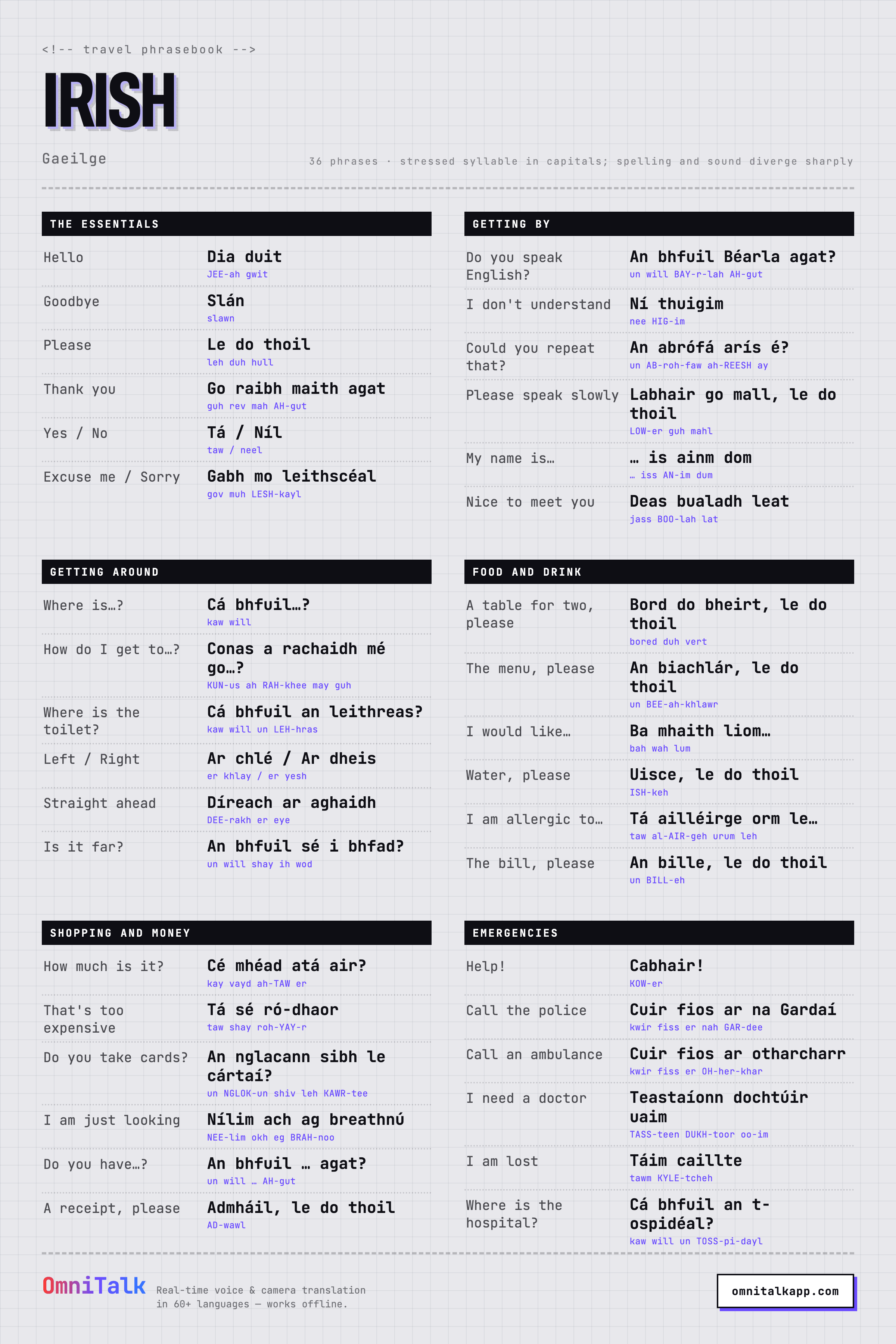
The whole card, on one page
All 36 phrases on a single sheet — print it, fold it into a passport, or keep it on your phone. Free, no signup, no watermark.
Or print this page directly — it drops the navigation and comes out as the phrase tables alone.
The essentials
The six words that carry most of a trip.
| English | Irish |
|---|---|
| Hello | Dia duitJEE-ah gwitLiterally "God to you". The set reply is "Dia is Muire duit". |
| Goodbye | Slánslawn |
| Please | Le do thoilleh duh hull |
| Thank you | Go raibh maith agatguh rev mah AH-gut |
| Yes / No | Tá / Níltaw / neelNot really yes and no — they mean "is" and "is not". See the note above. |
| Excuse me / Sorry | Gabh mo leithscéalgov muh LESH-kayl |
Getting by
What to say when the conversation outruns you.
| English | Irish |
|---|---|
| Do you speak English? | An bhfuil Béarla agat?un will BAY-r-lah AH-gutEveryone does. Irish is the courtesy here, not the necessity. |
| I don't understand | Ní thuigimnee HIG-im |
| Could you repeat that? | An abrófá arís é?un AB-roh-faw ah-REESH ay |
| Please speak slowly | Labhair go mall, le do thoilLOW-er guh mahl |
| My name is… | … is ainm dom… iss AN-im dum |
| Nice to meet you | Deas bualadh leatjass BOO-lah lat |
Getting around
Streets, stations and the one question everyone needs.
| English | Irish |
|---|---|
| Where is…? | Cá bhfuil…?kaw will |
| How do I get to…? | Conas a rachaidh mé go…?KUN-us ah RAH-khee may guh |
| Where is the toilet? | Cá bhfuil an leithreas?kaw will un LEH-hras |
| Left / Right | Ar chlé / Ar dheiser khlay / er yesh |
| Straight ahead | Díreach ar aghaidhDEE-rakh er eye |
| Is it far? | An bhfuil sé i bhfad?un will shay ih wod |
Food and drink
Ordering, allergies, and asking for the bill.
| English | Irish |
|---|---|
| A table for two, please | Bord do bheirt, le do thoilbored duh vert |
| The menu, please | An biachlár, le do thoilun BEE-ah-khlawr |
| I would like… | Ba mhaith liom…bah wah lum |
| Water, please | Uisce, le do thoilISH-kehUisce beatha, "water of life", is where whiskey comes from. |
| I am allergic to… | Tá ailléirge orm le…taw al-AIR-geh urum leh |
| The bill, please | An bille, le do thoilun BILL-eh |
Shopping and money
Prices, cards, and politely not buying anything.
| English | Irish |
|---|---|
| How much is it? | Cé mhéad atá air?kay vayd ah-TAW er |
| That's too expensive | Tá sé ró-dhaortaw shay roh-YAY-r |
| Do you take cards? | An nglacann sibh le cártaí?un NGLOK-un shiv leh KAWR-tee |
| I am just looking | Nílim ach ag breathnúNEE-lim okh eg BRAH-noo |
| Do you have…? | An bhfuil … agat?un will … AH-gut |
| A receipt, please | Admháil, le do thoilAD-wawl |
Emergencies
Worth reading once before you need them.
| English | Irish |
|---|---|
| Help! | Cabhair!KOW-er |
| Call the police | Cuir fios ar na Gardaíkwir fiss er nah GAR-deeEmergency number is 112 or 999. |
| Call an ambulance | Cuir fios ar otharcharrkwir fiss er OH-her-khar |
| I need a doctor | Teastaíonn dochtúir uaimTASS-teen DUKH-toor oo-im |
| I am lost | Táim cailltetawm KYLE-tcheh |
| Where is the hospital? | Cá bhfuil an t-ospidéal?kaw will un TOSS-pi-dayl |
<!-- saying it right -->
Four things that fix
most of the accent
There is no word for yes or no
You answer with the verb instead. "An bhfuil tú go maith?" is answered "Tá" (I am) or "Níl" (I am not). This carries into Irish English, which is why people say "I do" and "I have" where others say yes.
bh and mh sound like v or w
Gabh is "gov", leithscéal is "LESH-kayl", and Siobhán is "shiv-AWN". The h after a consonant does not make a "huh" sound; it changes the consonant entirely.
The police are the Gardaí
Pronounced "GAR-dee", singular Garda. Nobody in Ireland says "police", in English or Irish, so this is the word to use even in an emergency conversation held in English.
Consonants change next to different vowels
A consonant beside a, o or u is "broad"; beside i or e it is "slender" and takes on a y-glide. It is why "Dia duit" comes out as "JEE-ah gwit" rather than anything the spelling suggests.
Spotted a mistake in the Irish? Tell us and we will fix it.
You will not remember
all 36
Nobody does. OmniTalk speaks Irish for you in real time — point the camera at a menu, or put the phone between you and let it translate both sides of the conversation as you talk. It works offline once you download the language, so it keeps going when your roaming does not.