omnitalkapp.com/phrasebook/chinese
<!-- chinese phrasebook -->
36 common phrases
in Chinese (printable)
how to say hello in chinese
你好 — nǐ hǎo — nee HOW — is how you say hello in Chinese. It works at any hour, anywhere the language is spoken, with anyone. Pair it with 谢谢 (xiè xie — SYEH-syeh) for thank you and you already have the two words you will use most.
Below are the 36 most common phrases in Chinese worth knowing before you land, grouped by the situation you will need them in. Every one has a plain-English respelling — pinyin with tone marks, then a plain respelling — because IPA is no use to anyone standing at a pharmacy counter. Mainland China, Singapore and Chinese communities worldwide — roughly 940 million native Mandarin speakers, more than any other language on earth. People also search for these as common phrases in China, or under Mandarin, Putonghua.
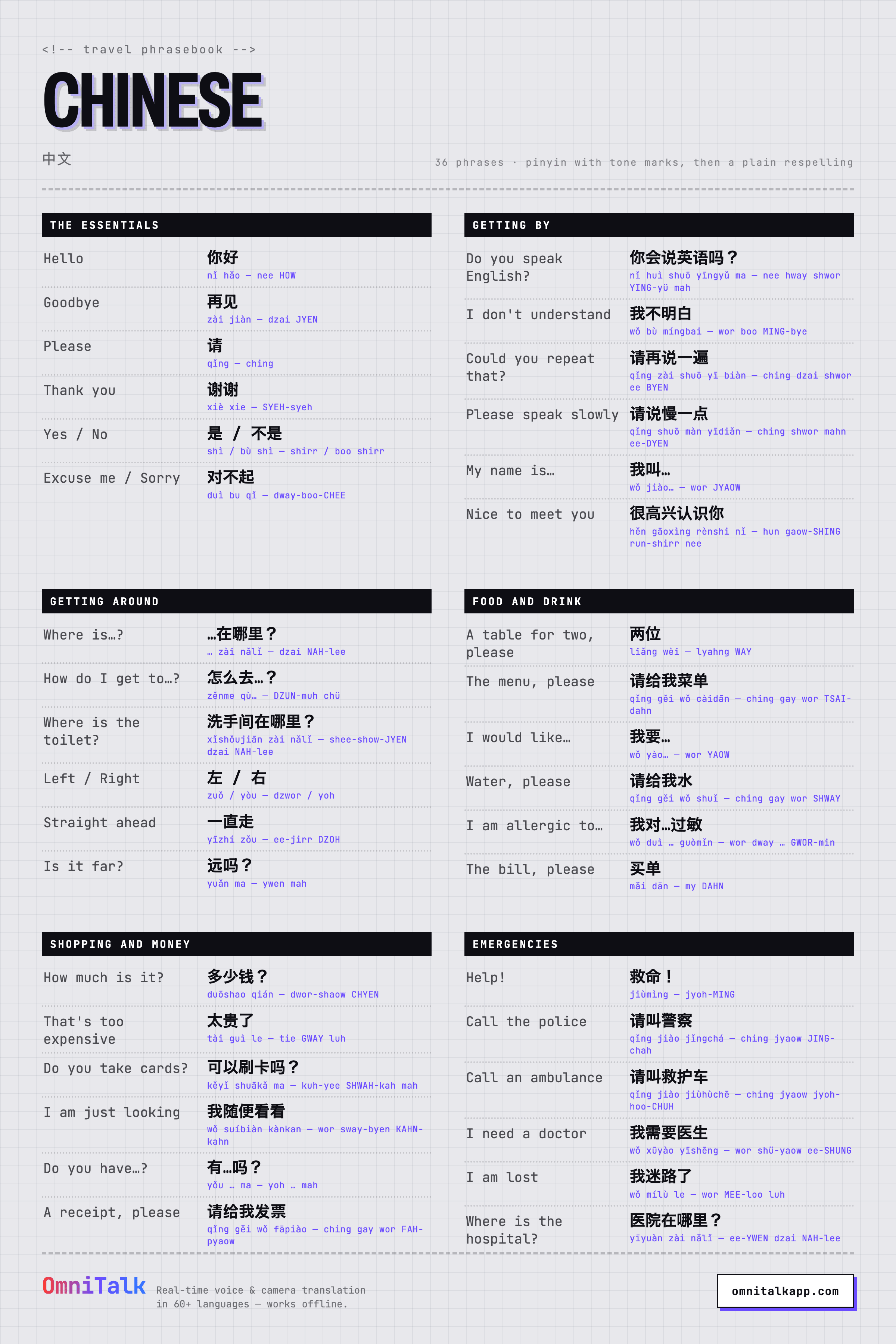
take it with you
The whole card, on one page
All 36 phrases on a single sheet — print it, fold it into a passport, or keep it on your phone. Free, no signup, no watermark.
Or print this page directly — it drops the navigation and comes out as the phrase tables alone.
The essentials
The six words that carry most of a trip.
| English | Chinese |
|---|---|
| Hello | 你好nǐ hǎo — nee HOW |
| Goodbye | 再见zài jiàn — dzai JYEN |
| Please | 请qǐng — ching |
| Thank you | 谢谢xiè xie — SYEH-syeh |
| Yes / No | 是 / 不是shì / bù shì — shirr / boo shirr |
| Excuse me / Sorry | 对不起duì bu qǐ — dway-boo-CHEE |
Getting by
What to say when the conversation outruns you.
| English | Chinese |
|---|---|
| Do you speak English? | 你会说英语吗?nǐ huì shuō yīngyǔ ma — nee hway shwor YING-yü mah |
| I don't understand | 我不明白wǒ bù míngbai — wor boo MING-bye |
| Could you repeat that? | 请再说一遍qǐng zài shuō yī biàn — ching dzai shwor ee BYEN |
| Please speak slowly | 请说慢一点qǐng shuō màn yīdiǎn — ching shwor mahn ee-DYEN |
| My name is… | 我叫…wǒ jiào… — wor JYAOW |
| Nice to meet you | 很高兴认识你hěn gāoxìng rènshi nǐ — hun gaow-SHING run-shirr nee |
Getting around
Streets, stations and the one question everyone needs.
| English | Chinese |
|---|---|
| Where is…? | …在哪里?… zài nǎlǐ — dzai NAH-lee |
| How do I get to…? | 怎么去…?zěnme qù… — DZUN-muh chü |
| Where is the toilet? | 洗手间在哪里?xǐshǒujiān zài nǎlǐ — shee-show-JYEN dzai NAH-lee |
| Left / Right | 左 / 右zuǒ / yòu — dzwor / yoh |
| Straight ahead | 一直走yīzhí zǒu — ee-jirr DZOH |
| Is it far? | 远吗?yuǎn ma — ywen mah |
Food and drink
Ordering, allergies, and asking for the bill.
| English | Chinese |
|---|---|
| A table for two, please | 两位liǎng wèi — lyahng WAYLiterally "two places" — said at the door. |
| The menu, please | 请给我菜单qǐng gěi wǒ càidān — ching gay wor TSAI-dahn |
| I would like… | 我要…wǒ yào… — wor YAOW |
| Water, please | 请给我水qǐng gěi wǒ shuǐ — ching gay wor SHWAY |
| I am allergic to… | 我对…过敏wǒ duì … guòmǐn — wor dway … GWOR-min |
| The bill, please | 买单mǎi dān — my DAHN |
Shopping and money
Prices, cards, and politely not buying anything.
| English | Chinese |
|---|---|
| How much is it? | 多少钱?duōshao qián — dwor-shaow CHYEN |
| That's too expensive | 太贵了tài guì le — tie GWAY luh |
| Do you take cards? | 可以刷卡吗?kěyǐ shuākǎ ma — kuh-yee SHWAH-kah mah |
| I am just looking | 我随便看看wǒ suíbiàn kànkan — wor sway-byen KAHN-kahn |
| Do you have…? | 有…吗?yǒu … ma — yoh … mah |
| A receipt, please | 请给我发票qǐng gěi wǒ fāpiào — ching gay wor FAH-pyaow |
Emergencies
Worth reading once before you need them.
| English | Chinese |
|---|---|
| Help! | 救命!jiùmìng — jyoh-MING |
| Call the police | 请叫警察qǐng jiào jǐngchá — ching jyaow JING-chah |
| Call an ambulance | 请叫救护车qǐng jiào jiùhùchē — ching jyaow jyoh-hoo-CHUH |
| I need a doctor | 我需要医生wǒ xūyào yīshēng — wor shü-yaow ee-SHUNG |
| I am lost | 我迷路了wǒ mílù le — wor MEE-loo luh |
| Where is the hospital? | 医院在哪里?yīyuàn zài nǎlǐ — ee-YWEN dzai NAH-lee |
<!-- saying it right -->
Four things that fix
most of the accent
Four tones, and they change the word
mā is mother, má is hemp, mǎ is horse, mà is to scold — same syllable. The marks above the vowels in the pinyin below are the tones: ā flat and high, á rising, ǎ dipping then rising, à falling sharply.
Getting a tone wrong is rarely fatal
Context carries most of it. Nobody in a restaurant thinks you are asking for a horse. Say the phrase with confidence rather than freezing over the tone.
Pinyin letters are not English letters
q is roughly "ch", x is roughly "sh", zh is "j", c is "ts", and r is somewhere near a French j. This is why every phrase below also has a plain respelling.
ü is "ee" with rounded lips
In 去 (qù, to go) and 女 (nǚ, woman). Say "ee", then round your lips into a whistle shape without moving your tongue.
Spotted a mistake in the Chinese? Tell us and we will fix it.
You will not remember
all 36
Nobody does. OmniTalk speaks Chinese for you in real time — point the camera at a menu, or put the phone between you and let it translate both sides of the conversation as you talk. It works offline once you download the language, so it keeps going when your roaming does not.