omnitalkapp.com/phrasebook/german
<!-- german phrasebook -->
36 common phrases
in German (printable)
how to say hello in german
Hallo — HAH-loh — is how you say hello in German. It works at any hour, anywhere the language is spoken, with anyone. Pair it with Danke (DAHN-kuh) for thank you and you already have the two words you will use most.
Below are the 36 most common phrases in German worth knowing before you land, grouped by the situation you will need them in. Every one has a plain-English respelling — stressed syllable in capitals — because IPA is no use to anyone standing at a pharmacy counter. Germany, Austria, Switzerland, Liechtenstein and parts of Belgium and Italy — around 135 million speakers, the most widely spoken native language in Europe. People also search for these as common phrases in Germany, or under Austria, Swiss.
take it with you
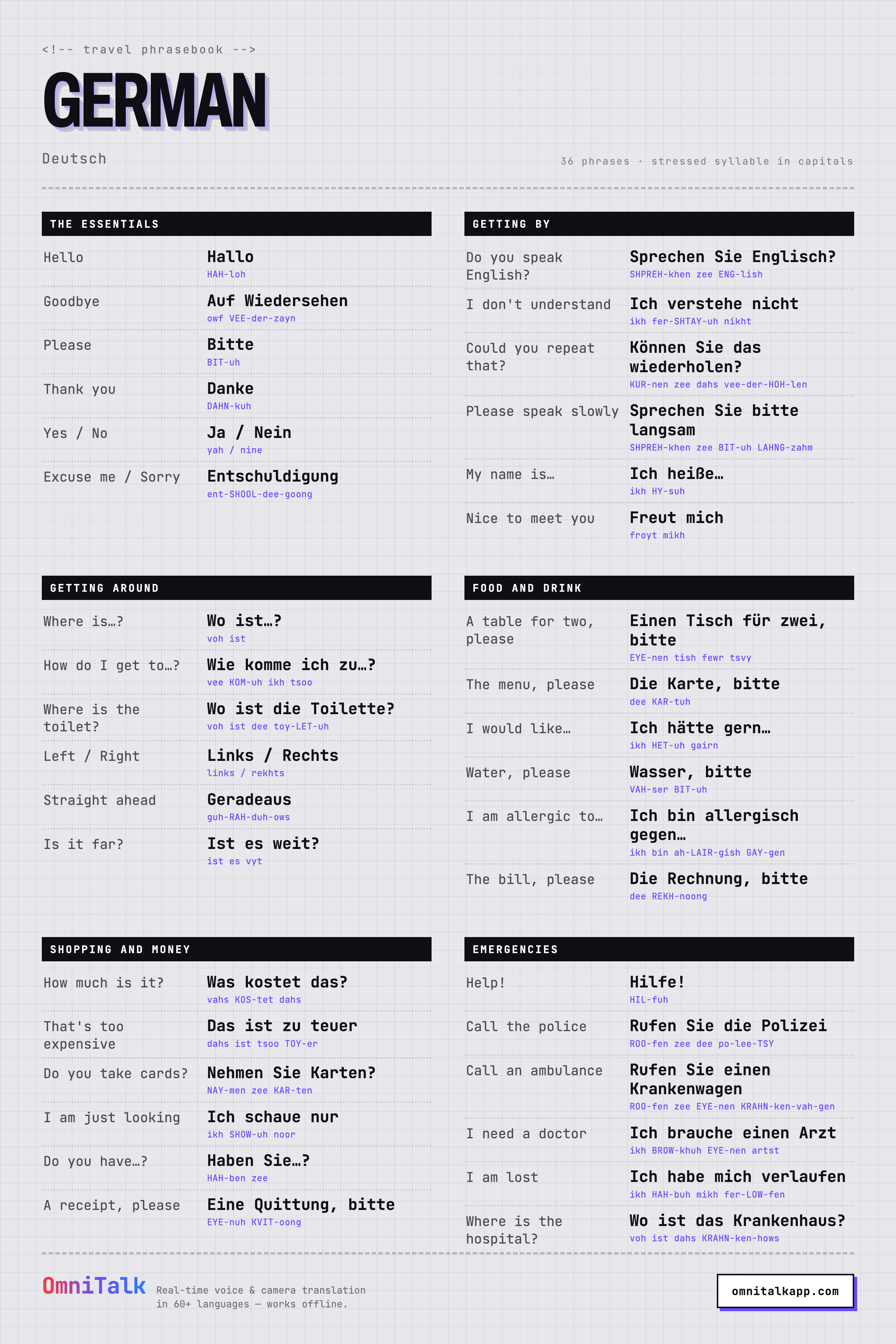
The whole card, on one page
All 36 phrases on a single sheet — print it, fold it into a passport, or keep it on your phone. Free, no signup, no watermark.
Or print this page directly — it drops the navigation and comes out as the phrase tables alone.
The essentials
The six words that carry most of a trip.
| English | German |
|---|---|
| Hello | HalloHAH-lohGuten Tag (GOO-ten tahk) is the more formal daytime greeting. |
| Goodbye | Auf Wiedersehenowf VEE-der-zaynTschüss (chewss) is the casual version. |
| Please | BitteBIT-uhAlso means "you’re welcome" and "here you are". |
| Thank you | DankeDAHN-kuh |
| Yes / No | Ja / Neinyah / nine |
| Excuse me / Sorry | Entschuldigungent-SHOOL-dee-goong |
Getting by
What to say when the conversation outruns you.
| English | German |
|---|---|
| Do you speak English? | Sprechen Sie Englisch?SHPREH-khen zee ENG-lish |
| I don't understand | Ich verstehe nichtikh fer-SHTAY-uh nikht |
| Could you repeat that? | Können Sie das wiederholen?KUR-nen zee dahs vee-der-HOH-len |
| Please speak slowly | Sprechen Sie bitte langsamSHPREH-khen zee BIT-uh LAHNG-zahm |
| My name is… | Ich heiße…ikh HY-suh |
| Nice to meet you | Freut michfroyt mikh |
Getting around
Streets, stations and the one question everyone needs.
| English | German |
|---|---|
| Where is…? | Wo ist…?voh ist |
| How do I get to…? | Wie komme ich zu…?vee KOM-uh ikh tsoo |
| Where is the toilet? | Wo ist die Toilette?voh ist dee toy-LET-uh |
| Left / Right | Links / Rechtslinks / rekhts |
| Straight ahead | Geradeausguh-RAH-duh-ows |
| Is it far? | Ist es weit?ist es vyt |
Food and drink
Ordering, allergies, and asking for the bill.
| English | German |
|---|---|
| A table for two, please | Einen Tisch für zwei, bitteEYE-nen tish fewr tsvy |
| The menu, please | Die Karte, bittedee KAR-tuh |
| I would like… | Ich hätte gern…ikh HET-uh gairn |
| Water, please | Wasser, bitteVAH-ser BIT-uh |
| I am allergic to… | Ich bin allergisch gegen…ikh bin ah-LAIR-gish GAY-gen |
| The bill, please | Die Rechnung, bittedee REKH-noong |
Shopping and money
Prices, cards, and politely not buying anything.
| English | German |
|---|---|
| How much is it? | Was kostet das?vahs KOS-tet dahs |
| That's too expensive | Das ist zu teuerdahs ist tsoo TOY-er |
| Do you take cards? | Nehmen Sie Karten?NAY-men zee KAR-ten |
| I am just looking | Ich schaue nurikh SHOW-uh noor |
| Do you have…? | Haben Sie…?HAH-ben zee |
| A receipt, please | Eine Quittung, bitteEYE-nuh KVIT-oong |
Emergencies
Worth reading once before you need them.
| English | German |
|---|---|
| Help! | Hilfe!HIL-fuh |
| Call the police | Rufen Sie die PolizeiROO-fen zee dee po-lee-TSY |
| Call an ambulance | Rufen Sie einen KrankenwagenROO-fen zee EYE-nen KRAHN-ken-vah-gen |
| I need a doctor | Ich brauche einen Arztikh BROW-khuh EYE-nen artst |
| I am lost | Ich habe mich verlaufenikh HAH-buh mikh fer-LOW-fen |
| Where is the hospital? | Wo ist das Krankenhaus?voh ist dahs KRAHN-ken-hows |
<!-- saying it right -->
Four things that fix
most of the accent
ch has two different sounds
After a, o or u it is a throaty rasp — Buch, machen. After e, i or a consonant it is a soft hiss made at the front of the mouth — ich, nicht, Milch. Neither is a K.
ei is "eye", ie is "ee"
The second letter tells you the sound. Nein is "nine", vier is "feer", Bier is "beer", drei is "dry". This one rule fixes a great many words at once.
w is v, v is f, z is ts, s before a vowel is z
Wasser is VAH-ser. Vier is feer. Zeit is tsyt. Sie is zee. Four swaps, and German spelling stops fighting you.
ü and ö are "ee" and "eh" with rounded lips
Say "ee", then round your lips without moving your tongue — that is ü. Do the same from "eh" for ö. Approximating them with "oo" and "er" is understood.
Spotted a mistake in the German? Tell us and we will fix it.
You will not remember
all 36
Nobody does. OmniTalk speaks German for you in real time — point the camera at a menu, or put the phone between you and let it translate both sides of the conversation as you talk. It works offline once you download the language, so it keeps going when your roaming does not.